Main Objective
Examine the effect of blended second-hand clothing fibres on the performance of mortar.

Practical sustainability and community development across Africa.
Examining how blended second-hand clothing fibres can turn textile waste into a lower-impact mortar while maintaining practical engineering performance.
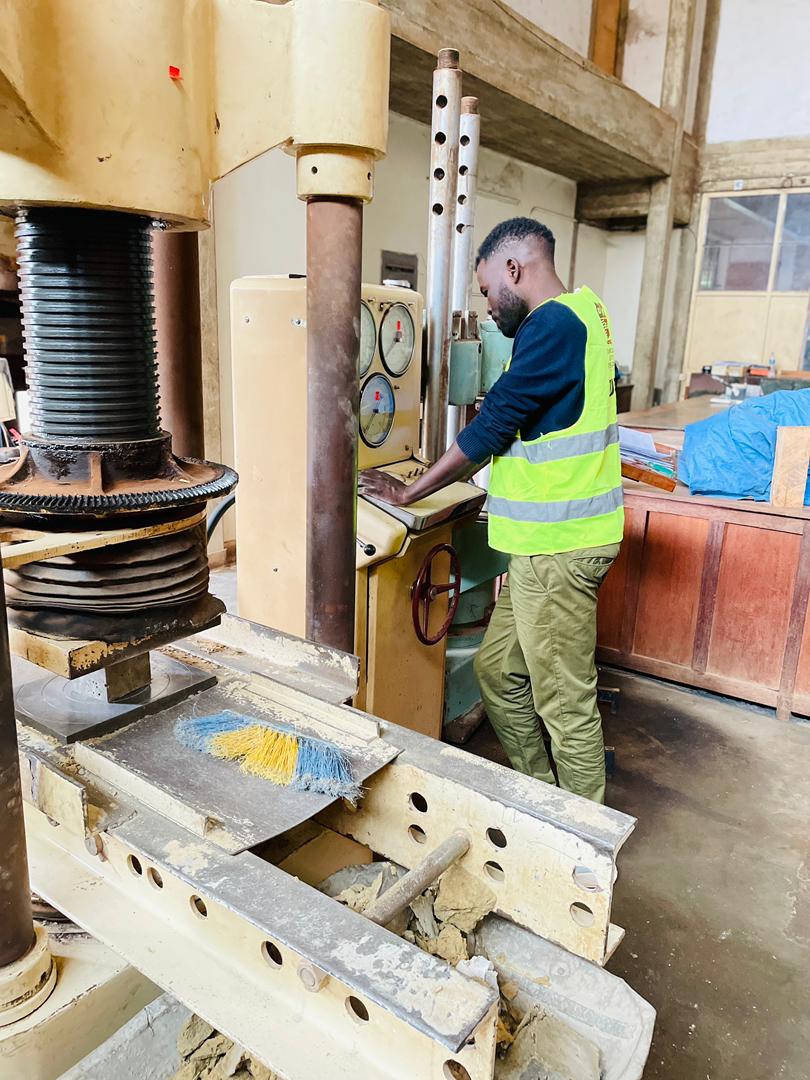
This study evaluated blended fibres from second-hand clothing as reinforcement in cement mortar. Four mixes with 0%, 0.5%, 1.0% and 1.5% fibre content were tested using a 1:3 cement-to-sand ratio and a 0.5 water-cement ratio. The work connects textile-waste recovery with practical construction research, measuring workability, compressive strength and water absorption.
Second-hand clothing that can no longer be reused often enters landfill or is burned. At the same time, conventional mortar is prone to cracking and brittle failure. This research explores whether mixed post-consumer textile fibres can reduce waste while improving the post-cracking behaviour of mortar.
Examine the effect of blended second-hand clothing fibres on the performance of mortar.
Assess how varying proportions of fibres affect the flow and consistency of fresh mortar.
Evaluate the effect of clothing fibres on mortar strength at 7, 14 and 28 days.
Measure how fibre content influences absorption and related durability behaviour.
The primary binder used to produce the mortar mixes.
Sand used as the fine aggregate at a 1:3 cement-to-sand ratio.
Blended fibres prepared from second-hand clothing sourced in Kampala.
Mixing and curing water used at a 0.5 water-cement ratio.
All mortar mixes were prepared and tested in controlled laboratory conditions using standard procedures.
Second-hand clothing was cleaned, cut and measured for consistent fibre content.
Control, 0.5%, 1.0% and 1.5% fibre mixes were prepared for comparison.
Mortar specimens were cast using a consistent 1:3 cement-to-sand mix.
Samples were cured for 7, 14 and 28 days before strength testing.
Flow-table, compressive-strength and water-absorption tests were completed.
Results were compared to identify the most balanced fibre percentage.
Low fibre content preserved mortar strength while improving its resistance to brittle, complete failure.
0.5%
Fibre content with the most balanced performance
23.3 MPa
28-day strength at 0.5% fibre content
24.33 MPa
Highest 28-day strength in the control mix
21 → 15 cm
Flow reduced as fibre content reached 1.5%
5.47 → 10.98%
Water absorption increased with fibre content
7–28 days
Strength development measured throughout curing
Blended clothing fibres can give post-consumer textiles a useful role in construction materials.
Fibre-reinforced specimens remained partly intact after cracking, unlike the brittle control specimens.
At 0.5%, fibres maintained strength close to the control mix; higher contents reduced workability and strength.