Main Objective
Evaluate the effect of powdered Gum Arabic on normal concrete workability, strength and chemical composition.

Practical sustainability and community development across Africa.
Evaluating powdered Gum Arabic as a natural, locally available additive for improving the workability and chemical behaviour of normal concrete.
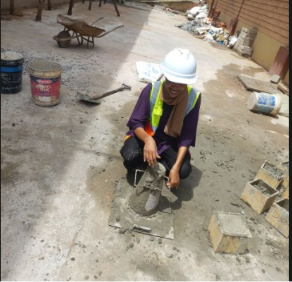
This study investigated powdered Gum Arabic as a natural additive in C25 normal concrete. Four mixes containing 0%, 0.5%, 1.0% and 1.5% Gum Arabic by cement weight were tested for slump, compressive strength at 7, 14 and 28 days, and chemical interactions using FTIR analysis.
Conventional chemical admixtures can be costly and less sustainable. Gum Arabic is a biodegradable natural biopolymer, widely available across the African Gum Belt, but its powdered use in normal concrete is not fully understood. This research tests its impact on fresh, hardened and chemical concrete properties.
Evaluate the effect of powdered Gum Arabic on normal concrete workability, strength and chemical composition.
Determine slump for concrete mixes containing different Gum Arabic dosages.
Assess strength development at 7, 14 and 28 days.
Identify chemical interactions between Gum Arabic and cement hydration products.
The main binder used in C25 concrete production.
A natural Acacia-tree biopolymer used from 0.5% to 1.5% by cement weight.
Fine and coarse aggregate used in a 1:2:4 control mix.
Water mixed with Gum Arabic before being added to dry ingredients.
Controlled C25 concrete specimens were batched, cast, cured and tested to compare Gum Arabic dosages.
Control, 0.5%, 1.0% and 1.5% Gum Arabic mixes were prepared.
Gum Arabic was mixed with water before combining with dry concrete ingredients.
Concrete cube specimens were cast under standard laboratory conditions.
Samples were cured for 7, 14 and 28 days.
Slump and compressive strength were measured for each concrete mix.
Infrared spectroscopy assessed functional groups and cement–Gum Arabic interactions.
Gum Arabic steadily improved workability but did not exceed the control mix in measured compressive strength.
12 → 16 cm
Slump increased from control to 1.5% Gum Arabic
1.0%
Best 28-day strength among Gum Arabic mixes
12 MPa
28-day strength for the 1.0% Gum Arabic mix
15 MPa
28-day strength of the control mix
980–1000 cm⁻¹
FTIR Si–O peak linked to C–S–H formation
1.5%
Highest workability but lowest 28-day strength
Increasing Gum Arabic dosage increased slump and ease of handling in fresh concrete.
Higher dosages reduced measured compressive strength; 1.0% gave the best strength of the modified mixes.
FTIR confirmed Gum Arabic coexisted with cement hydration products, supporting its controlled use as an eco-friendly additive.