Main Objective
Investigate the influence of crushed clay roof tiles on concrete performance.

Practical sustainability and community development across Africa.
Examining crushed clay roof tiles as a partial replacement for natural coarse aggregate to create reduced-density concrete from construction waste.
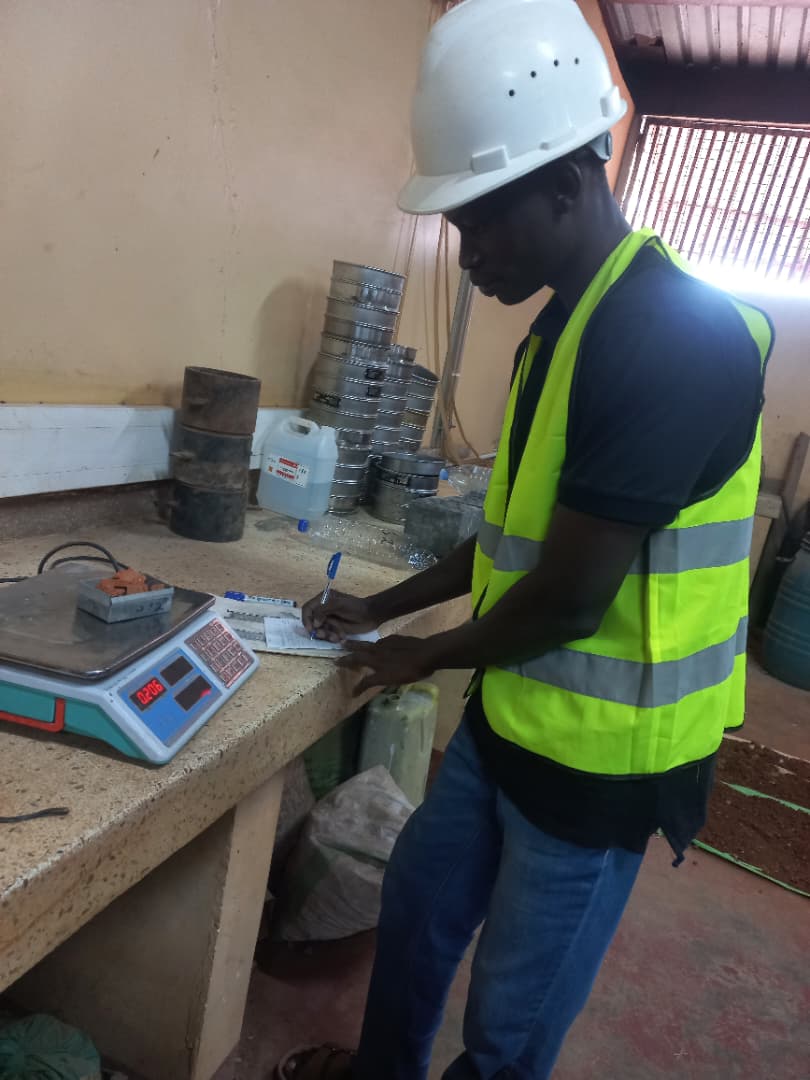
This M15 concrete study evaluated crushed clay roof tiles (CCRT) as a replacement for natural coarse aggregate at 0%, 10%, 25% and 35%. It measured slump, compressive strength, density, moisture content, water absorption, specific gravity and aggregate shape. The research turns roof-tile waste into a potential reduced-density construction material.
Natural aggregate extraction is resource-intensive, while broken clay roof tiles from construction and demolition are frequently discarded. The research tests how much natural coarse aggregate can be replaced without losing the concrete performance needed for practical applications.
Investigate the influence of crushed clay roof tiles on concrete performance.
Assess how CCRT replacement changes the slump of fresh concrete.
Determine compressive strength and reduced-density potential at each level.
Evaluate whether recycled tiles provide a viable material alternative.
The binding material for the M15 concrete mix.
Recycled clay roof-tile particles used in place of natural coarse aggregate.
Fine aggregate and natural coarse aggregate for the control mix.
Mixing water, with pre-soaking recommended for porous CCRT.
Concrete mixes were cast and assessed under standard laboratory conditions from 7 to 28 days.
Roof-tile waste was crushed, sieved and characterised for concrete use.
Four mixes replaced 0–35% of natural coarse aggregate by CCRT.
Concrete cubes were prepared using a 1:2:4 mix and 0.45 water-cement ratio.
Specimens were cured and measured at 7, 14 and 28 days.
Slump, strength, density, moisture and absorption were tested.
Results were used to find the balance between reduced weight and performance.
CCRT reduced density, but its high porosity reduced workability and strength at higher replacement levels.
10–25%
Optimum CCRT replacement range
24.53 MPa
28-day control strength
19.28 MPa
28-day strength at 35% CCRT
130 → 27 mm
Slump decrease from control to 35% replacement
2.15
Bulk specific gravity of CCRT
16.30%
Water absorption of porous CCRT
Crushed roof tiles can divert demolition waste from disposal and conserve aggregates.
10–25% offered the best compromise between adequate strength and lower density.
Pre-soaking CCRT is essential to control water demand and workability.