Main Objective
Determine the effect of basalt rock powder on the physical and mechanical properties of concrete.

Practical sustainability and community development across Africa.
Investigating basalt rock powder as a supplementary cementitious material that can improve concrete performance while reducing cement use.
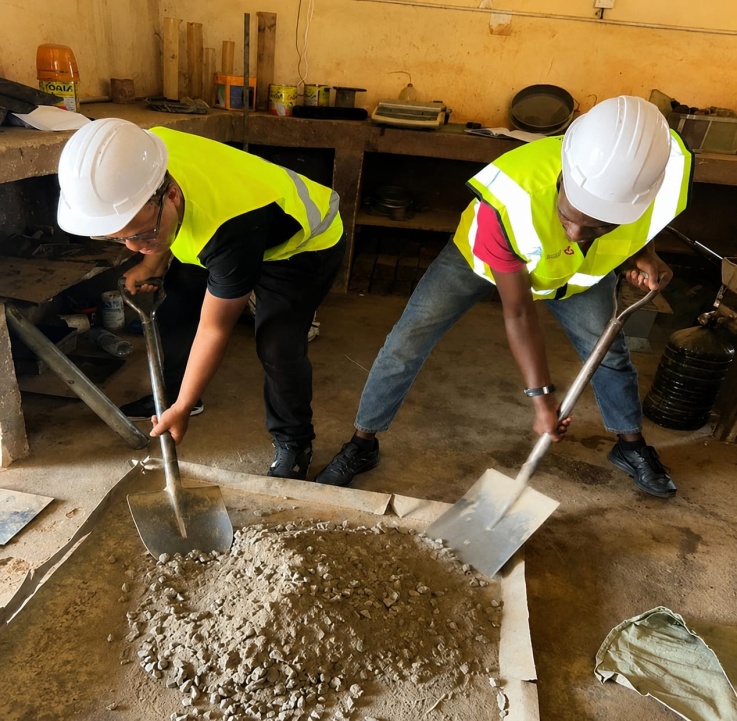
This study examined concrete where basalt rock powder (BRP) replaced 0%, 10%, 15%, 20%, 25% and 30% of cement. Basalt sourced from Kibaale District was crushed into powder, then evaluated with conventional concrete materials to identify the replacement level that delivers the strongest, most workable concrete.
Cement production is resource- and energy-intensive and produces substantial carbon dioxide emissions. Basalt rock powder is abundant and contains reactive mineral compounds, but the most effective proportion for replacing cement must be established to protect fresh and hardened concrete performance.
Determine the effect of basalt rock powder on the physical and mechanical properties of concrete.
Determine the chemical properties and composition of the basalt rock powder.
Assess workability and setting behaviour across the BRP proportions.
Identify the best cement-replacement percentage in hardened concrete.
The primary binder, partly replaced with basalt rock powder.
Crushed basalt from Kibaale District, characterised for its chemical and physical properties.
Fine sand and crushed coarse aggregate tested for grading, density and strength.
Mixing water used in the controlled concrete mix design.
Laboratory tests at Energo Laboratory, Kawanda, compared fresh and hardened concrete performance across six BRP replacement levels.
Basalt was collected from Zirobwe Quarry and crushed into powder.
Aggregate quality and BRP chemistry were assessed, including X-ray fluorescence testing.
Six mixes contained 0%, 10%, 15%, 20%, 25% and 30% BRP in place of cement.
150 mm concrete cubes were prepared for every mixture.
Cubes were cured and assessed at 7, 14 and 28 days.
Slump, setting time and compressive strength identified the optimum mix.
Strength increased as BRP rose to 15%, then decreased at higher replacement levels.
15%
Optimum basalt rock powder replacement of cement
25.6 MPa
28-day compressive strength at 15% BRP
24.8 MPa
28-day control concrete strength
19.5 MPa
28-day strength at 30% BRP replacement
52 mm
Workability measured for the optimum 15% mix
7.0 hrs
Setting time recorded at the optimum replacement level
Dominant silica, iron oxide and calcium oxide supported BRP's pozzolanic potential.
The 15% mix exceeded the control strength and the 25 MPa target.
15% BRP provided the best balance of strength, workability and setting time.